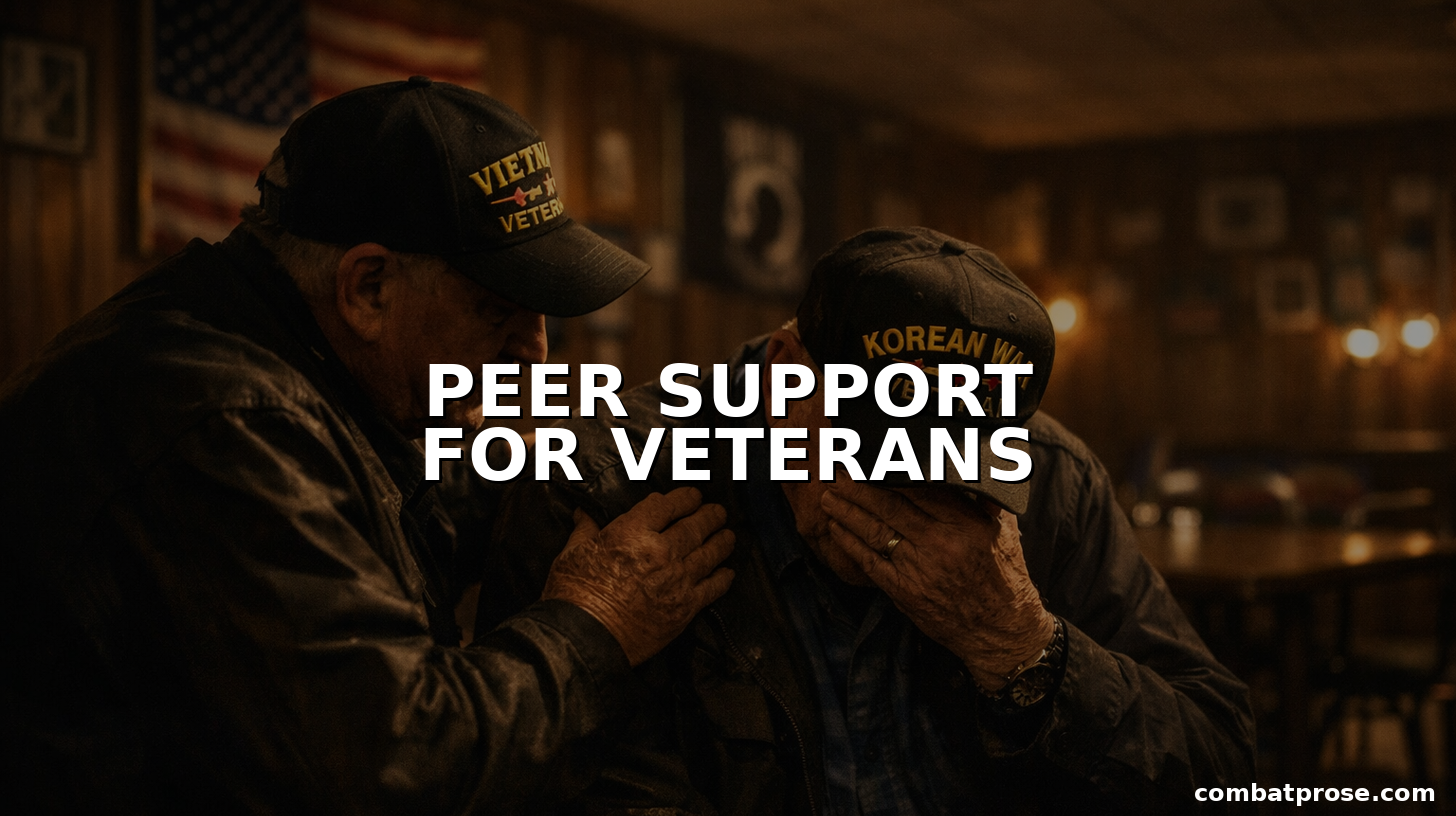
There’s a version of “getting help” that looks like sitting in a waiting room filling out intake forms for a clinician who has never worn a uniform, never deployed, never had to figure out what to do when the mission ends. That version works for some people. For a lot of veterans, it doesn’t. That’s the gap that veteran peer support programs are built to close.
And then there’s the version where someone who served — who actually knows what it feels like when the structure disappears overnight — looks at you and says: I’ve been there. Here’s what I did. That version works differently.
The data backs this up. Research cited by veteran support organizations shows that peer-led programs achieve 40% higher engagement rates compared to traditional support services. That’s not a minor efficiency gain. That’s the difference between a veteran walking through the door or not.
Why Peer Support Works (The Science Part)
The mechanism isn’t complicated. Trust is the barrier. Clinical settings, no matter how well-intentioned, require a veteran to bridge a gap — to explain a world that the person across the desk has never lived in. That gap takes time and energy to bridge, and a lot of veterans run out of both before they get to the actual problem.
Peer support eliminates that gap. A shared military background creates what one VA peer specialist described as a connection that is “already in place.” The National Veterans’ Training Institute puts it this way: “Veterans are more likely to seek help and follow through when supported by someone who ‘gets it.’”
Research on veteran peer support programs has found measurable improvements across multiple domains:
- Increased social support and reduced isolation
- Reduced clinical symptoms (PTSD, depression)
- Improved self-efficacy — the belief that you can actually handle what’s in front of you
- Greater willingness to seek additional help when needed
- Stronger outcomes in employment, housing, and education
The Mission Continues found in a 2017 study that veterans who completed their civic service fellowship program reported decreased rates of social isolation and loneliness, and an increased sense of social support — specifically from re-creating the camaraderie culture they lost at separation. That culture — where people watch each other’s backs as a default — doesn’t transfer automatically to civilian life. Peer programs are one of the few things that replicate it.
For more on the mental health side of this equation, read our post on Mental Health Resources That Actually Work (From a Vet Who’s Used Them).
The Programs That Are Doing This Right
Team RWB (Red, White & Blue)
Team RWB is built on a simple premise: physical activity plus community equals resilience. Their model connects veterans, service members, military families, and civilian supporters through fitness events, monthly missions, and a chapter network spread across the country.
The structure matters. Monthly missions give you a defined goal and a group of people working toward it alongside you. The shared challenge — run 100 miles, complete a functional fitness workout, climb 2,200 stairs — creates exactly the kind of common experience that generates real connection. It’s not a support group. It’s a unit that happens to be in your zip code.
If you’re newly separated and struggling to figure out what your social life looks like without a base, Team RWB is one of the most practical first moves you can make. Find a chapter at teamrwb.org/find-your-chapter.
The Mission Continues / Travis Manion Foundation
In 2025, The Mission Continues was acquired by the Travis Manion Foundation, bringing two organizations together with a combined reach of nearly 60 communities nationwide. Their model is service-based: veterans don’t just receive support, they lead it — organizing volunteer platoons, running service projects, and building professional networks in the process.
The research on their model is clear. In their 2017 survey, 67% of participants said connecting with other veterans was a primary reason for getting involved, and 75% reported feeling more connected to other veterans after participation. More than three in five (63%) said they built more professional networking opportunities through the program.
The peer dynamic here is slightly different from crisis support — it’s about restoring purpose and identity through service rather than managing acute distress. But that’s exactly what a lot of veterans need in the first year or two post-separation: something that looks and feels like a mission.
Programs include the Service Leadership Corps, the Women Veterans Leadership Program, and mass deployment service events. Learn more at missioncontinues.org.
Vets4Warriors
In November 2025, Vets4Warriors hit one million connections. That milestone matters because every one of those was a service member, veteran, or family member who reached out and got a peer — someone who served — on the other end of the line.
The program averages over 770 first-time callers every month, 26 per day. They handle everything from loneliness and isolation to financial pressures, transition challenges, and family issues. Calls are answered in under 30 seconds. Confidential. Available 24/7, 365 days a year.
Here’s the number: 1-855-838-8255. Or chat online at vets4warriors.com. This is the peer support version of the Veterans Crisis Line — for when you’re not in crisis, but you’re not okay either, and you just need to talk to someone who gets it.
VA Peer Support Specialists
The VA runs the largest peer specialist employer in the world. More than 1,000 peer specialists have been hired in VA mental health settings, and the program has expanded to embed peer specialists in primary care Patient-Aligned Care Teams (PACTs) as well.
A VA Peer Support Specialist is a veteran with lived mental health experience — actively in their own recovery — who has been trained and certified to help other veterans. They can:
- Share their own experience with mental health challenges, PTSD, or substance use
- Help you set and work toward specific life and recovery goals
- Navigate the VA system alongside you (not just point you toward a website)
- Bridge the gap between you and the clinical team when that relationship isn’t clicking
The VA’s own research found that peer specialists are “highly regarded” by veterans and that their presence has a positive impact on care in over 96% of sites surveyed. That’s about as clear a mandate as you get in government research.
To access a VA Peer Support Specialist, ask your VA primary care provider or mental health team. They can also be found through the VA’s patient-aligned care teams.
PFC Joseph P. Dwyer Peer Support Program
Originally launched in New York, the Dwyer Program has expanded to 62 counties statewide, facilitated more than 12,000 support groups, and connected more than 300,000 veterans through individual face-to-face interactions. Congress is currently weighing H.R. 438, which would nationalize this model. The Disabled American Veterans and the Wounded Warrior Project both support it.
How to Find a Peer Mentor
Here’s where to start, depending on what you need:
- Community and fitness: Team RWB chapter locator
- Service and purpose: The Mission Continues / Travis Manion Foundation
- Peer phone or chat support (24/7): Vets4Warriors at 1-855-838-8255
- Clinical + peer support inside VA: Ask your VA care team about peer specialists at your facility
- Veterans Crisis Line (immediate crisis support): Call 988, press 1
- Local VSOs: Many VFW posts, American Legion chapters, and DAV offices run their own peer mentoring or can connect you with one
How to Become a Peer Mentor
If you’re in a good place and want to be the person for someone else that you needed when you got out, here are your options:
VA Peer Support Specialist (Paid, Certified Position)
The VA hires peer specialists as official employees in the GS-0102 series. To qualify, you need:
- Veteran status (active duty, any branch)
- Lived experience with mental health recovery
- Peer support certification from a state-approved training program (typically 40–80 hours of training)
You can obtain certification through a state-approved organization before applying, or enter as a Peer Support Apprentice (uncertified) and earn it while working. For details on the certification path, see VA Careers: Peer Specialist.
Team RWB Chapter Leadership
Volunteer chapter roles through the Team RWB member app — lead local events, organize monthly missions, build community. No formal certification required.
The Mission Continues Service Leadership Corps
Complete the Service Leadership Corps training and lead service platoons in your area. This is the civilian equivalent of getting a leadership billet — you’re running a team with a mission.
State and Local Peer Programs
Many states have their own peer support networks and certifications outside the VA. Mental Health America maintains a directory of state-approved peer specialist training programs.
Dr. Charles Hoge’s Once a Warrior, Always a Warrior is one of the best resources for understanding what your battle buddy might be going through.
The Bottom Line
The science behind veteran peer support programs is solid. The programs exist. The demand is there — Vets4Warriors didn’t reach a million connections because veterans don’t want help. They reached a million connections because veterans want help from people who understand them.
If you need support, start with one of the resources above. If you’re in a position to give it, consider getting certified or volunteering. The person who walks into Team RWB’s next event or calls Vets4Warriors tomorrow might be where you were three years ago. You already know how much it matters to have someone in your corner who actually gets it.
And if you’re still figuring out where you fit post-separation, check out Finding Your Tribe: Veteran Communities and Networks Worth Joining — it’s a good place to start.
Recommended Reading
- Once a Warrior, Always a Warrior — Dr. Charles Hoge’s practical guide to navigating the transition home, written specifically for combat veterans and their families.
- Tribe: On Homecoming and Belonging — Sebastian Junger on why veterans miss war — and what it says about the civilian world they come home to.
- Can’t Hurt Me — David Goggins’ raw memoir on mental toughness. Former Navy SEAL, no sugarcoating.
- The Body Keeps the Score — Dr. Bessel van der Kolk’s groundbreaking work on how trauma reshapes the body and brain — and paths to recovery.
This post contains affiliate links. If you purchase through these links, CombatProse may earn a small commission at no extra cost to you. See our Affiliate Disclosure for details.