By CombatProse · USMC
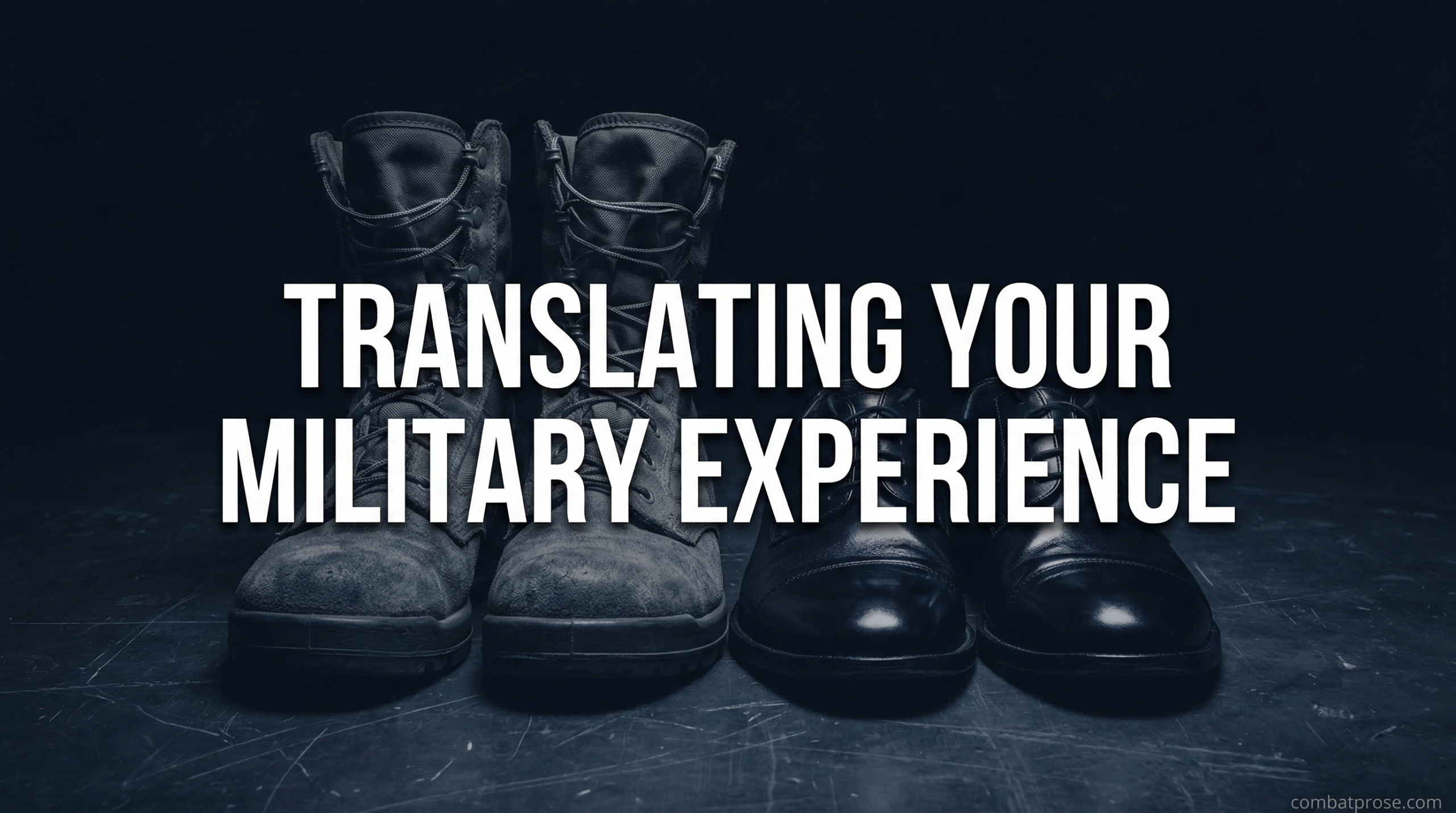
I remember sitting down to write my first civilian resume and staring at a blank page for about 20 minutes. I knew exactly what I’d done for three years in the Marine Corps. I had no idea how to explain it to someone who’d never worn a uniform.
The skills were there. The language to describe them wasn’t. That gap — between what you actually did and what a hiring manager can understand — is where a lot of military transitions go wrong. This article is about closing it.
Operation Job Search by John Henry Weiss treats the civilian job hunt exactly like a military operation — with tactics, timelines, and a battle rhythm for turning your MOS into a compelling resume.
Step One: Kill the Acronyms
I mean it. All of them.
Civilian hiring managers do not know what an E-7 is, what MOS 0311 means, what a SNCO does, or what “NCO in charge of a rifle squad during OIF” looks like on a day-to-day basis. They’re not ignorant — it’s just a completely different world with completely different vocabulary.
When they see a resume full of military jargon, they don’t Google it. They move on to the next resume.
Go through your resume and replace every acronym and military-specific term with plain language. Every single one. If it’s not self-explanatory to your brother-in-law who works in an office, rewrite it.
Common translations:
| Military term | Civilian equivalent |
|---|---|
| E-7 / Staff Sergeant | Senior Team Leader / Manager (7+ years) |
| MOS 0311 Infantry | Combat Operations / Security Operations |
| MOS 92A Logistics | Supply Chain and Inventory Management |
| MOS 25U Signal | IT Communications / Network Operations |
| Squad Leader (13 Marines) | Team Manager, 13 direct reports |
| Platoon Sergeant (40 Marines) | Operations Manager, 40-person team |
| First Sergeant (200+ Marines) | Senior Operations Manager, 200+ personnel |
| OIC / NCOIC | Officer in Charge / Senior Manager |
| After-Action Review | Performance Debrief / Process Improvement Review |
| TOC | Operations Center / Command Center |
You get the idea. Translate everything.
Mission Transition by Matthew Louis is the most comprehensive career translation guide written specifically for veterans — it treats your job search like a mission, with a clear framework from start to first paycheck.
Translate Roles, Not Just Titles
The title translation is just the start. You need to translate what you actually did — and quantify it wherever possible.
Instead of:
“Served as squad leader responsible for maintaining discipline and readiness of Marines.”
Write:
“Led a 13-person team responsible for personnel readiness, equipment maintenance, and mission execution across a 12-month deployment. Maintained 98% equipment operational readiness rate across 40+ combat patrols.”
Numbers make civilian hiring managers pay attention. Think about:
- How many people you supervised or led
- How much equipment or budget you were responsible for
- How many missions, operations, or projects you completed
- What percentage of time things were on schedule, on target, or mission-ready
- Any training you delivered — how many students, over what period
You probably managed more responsibility at 24 years old than most civilians do at 34. Show that in concrete terms.
Think of your transition like a PCS — PCS to Corporate America by Roger Cameron breaks down the corporate hiring process in terms any NCO or officer will immediately understand.
Use Hire Heroes USA
Before you send a single resume, get help from Hire Heroes USA. This is a free nonprofit that provides veteran career transition services — resume review, interview coaching, job search support, and more. Free. Completely free.
Their resume reviewers know military-to-civilian translation because that’s all they do. They’ll catch the jargon you’ve gone blind to, reframe your experience in ways that civilian employers understand, and help you build a document that actually opens doors.
I can’t stress this enough. Don’t skip this step. It takes maybe two hours of your time and it can meaningfully change your outcome.
LinkedIn: Your Civilian Professional Identity
Your LinkedIn profile is your civilian face to the professional world, and most transitioning veterans either don’t have one or have a profile that reads like a military service record.
A few things to get right:
Headline: This is the line under your name. Don’t put “USMC Veteran seeking opportunities.” Put what you want to do: “Operations Manager | Supply Chain | Military Veteran” or “Cybersecurity Professional | CompTIA Security+ | Veteran.” Think of it as a short pitch, not a status.
Summary section: Write in first person. Tell your story — where you came from, what you did, what you’re good at, and what kind of work you’re looking for. It should sound like a human being wrote it, because a human being should have written it.
Skills and endorsements: Map your military skills to civilian skill terms that LinkedIn recognizes. Leadership. Project Management. Operations Management. Logistics. Risk Management. Training and Development. These are keywords recruiters search for.
Connect proactively. Connect with people in the industry you’re targeting. Reach out to veterans who made similar transitions — most will respond. LinkedIn is a tool; it only works if you use it actively.
The Culture Shock of Corporate Life
Nobody warned me about this, and it blindsided me when I first worked in a civilian environment. So I’m warning you.
Corporate culture is profoundly different from military culture. Not necessarily worse — just different. Prepare yourself for:
Meetings about meetings. Civilian organizations will schedule a 45-minute meeting to discuss scheduling another meeting. This will make you want to flip a table. Don’t flip the table. Understand that civilian teams often build consensus through conversation rather than issuing orders, and that this is genuinely how they operate — not laziness, just a different system.
Ambiguous authority. In the military, the chain of command is clear. In corporate life, “leadership” is often distributed, contested, or just unclear. Multiple people have input on decisions. Nothing moves as fast as you expect. This is normal. It’s frustrating, but it’s normal.
Feedback culture is different. In the Corps, feedback could be blunt to the point of colorful. In corporate settings, people often wrap criticism in layers of softening language to the point where you might not realize you’re being criticized. Learn to read between the lines. Also, when you give feedback, calibrate it — your “honest assessment” may register as hostility to someone who’s never been through the military.
Your intensity can read as aggression. You operate with urgency and purpose. Civilians who haven’t worked with veterans sometimes read that as aggression or impatience. You’re not doing anything wrong, but you may need to consciously slow down your communication style until you build enough context for people to understand who you are.
Organizations That Can Help
Beyond Hire Heroes USA, a few organizations specifically connect veterans with civilian career opportunities:
American Corporate Partners: Mentorship program that pairs veterans with senior corporate executives for year-long, one-on-one professional development. This is high-quality access to people who can actually influence hiring decisions. Apply as early in your transition as possible.
Veterati: On-demand mentorship platform connecting veterans with volunteer mentors from business, tech, government, and entrepreneurship. More than 20,000 mentors. Free. Good for specific questions and ongoing guidance.
Hire Heroes USA: Already mentioned, but worth repeating — resume help, interview coaching, job board, and employer partnerships. Free. Use it.
The Bottom Line
The civilian job market is navigable. You have real skills. The challenge is communication — making sure the person on the other side of your resume or across the interview table can actually see what you bring.
Stop speaking military. Start speaking civilian. Get help from people who’ve made the same translation. And give yourself some grace during the learning curve — cultural transitions are hard, even when you’re moving toward something good.
You spent years becoming highly capable under extreme conditions. The goal now is just to make sure the people who could benefit from your capabilities can actually recognize them.
Have a specific military role you’re struggling to translate? Drop it in the comments and I’ll help you work through the language. That’s what this community is here for.
Recommended Reading
- Atomic Habits — Building the civilian career you want requires building the right daily systems. Your military discipline is an asset — channel it here.
- Principles — Dalio’s framework for decision-making and self-assessment maps directly onto the leadership experience you’re trying to sell to civilian employers.
- Zero to One — If corporate jobs feel like a dead end, this is the book that might point you toward building instead. Veterans start companies. This shows you how to think about it.
- Can’t Hurt Me — The mental edge Goggins describes — the refusal to accept mediocrity — is the thing that sets veteran candidates apart. This book helps you articulate it.
This post contains affiliate links. If you purchase through these links, CombatProse may earn a small commission at no extra cost to you. See our Affiliate Disclosure for details.